

We frequently receive questions about the correct waterproofing approach for Triotherm door upstands.
One of the most common questions is:
“Does Triotherm require a traditional DPC or DPM beneath the upstand?”
The answer is:
A conventional loose DPC or DPM layer beneath the Triotherm+ upstand is generally not required when the specified sealing and waterproofing detail is used.
Why? The explanation lies in the material itself and, more importantly, in the way the complete junction is sealed.
1. The Traditional DPC Approach

Conventional masonry or concrete upstands normally require a damp-proof layer to prevent moisture from travelling through the structure and into the building.
Traditionally, this is often achieved by placing a loose DPC or DPM membrane beneath or around the upstand.
While this principle is well established, loose membranes can create practical detailing challenges at door thresholds.
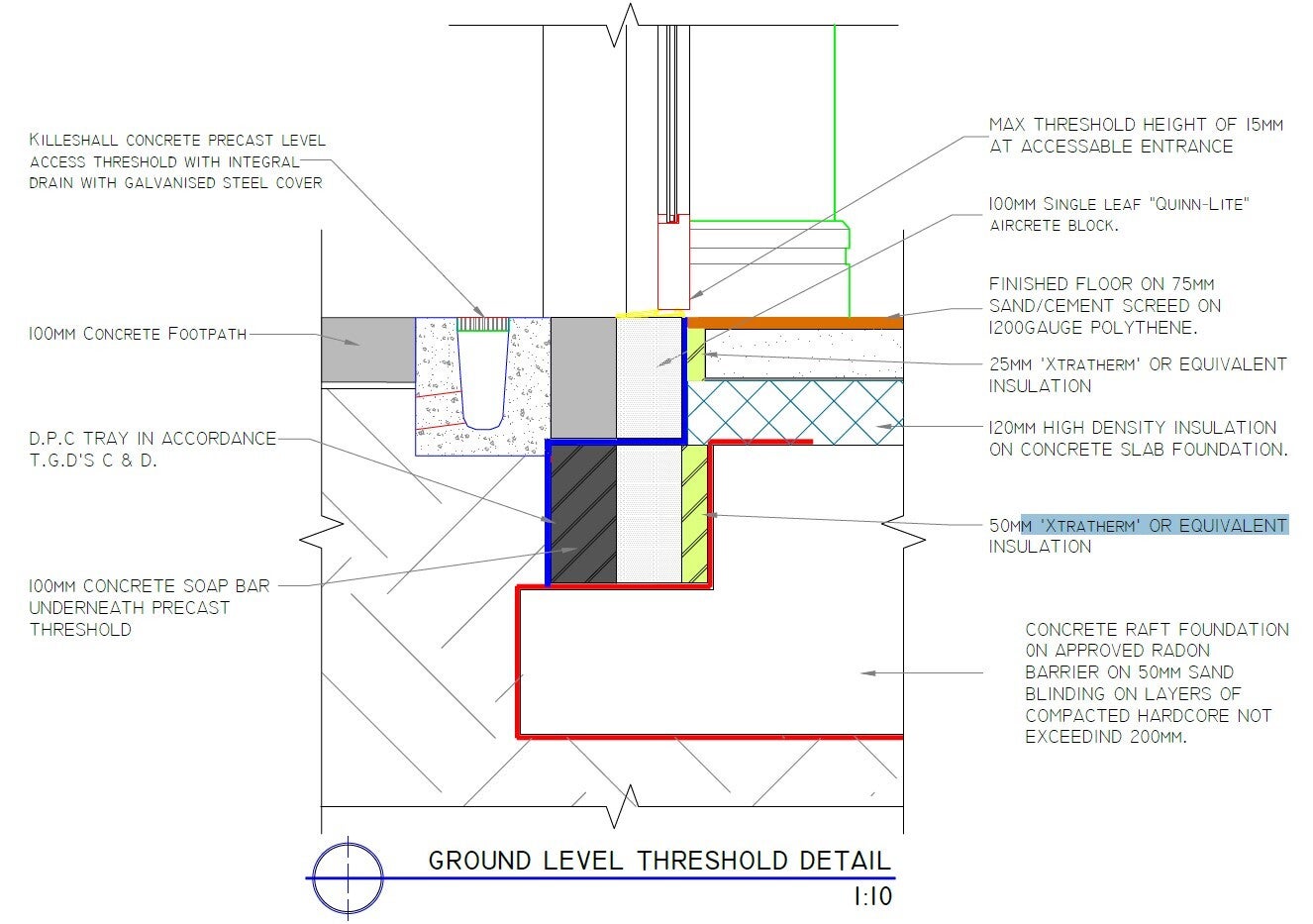
What can be the problem?
The critical issue is continuity.
At a door threshold, the waterproofing layer has to connect reliably with:
- the floor or radon membrane
- the door upstand
- the door frame
- the external waterproofing detail
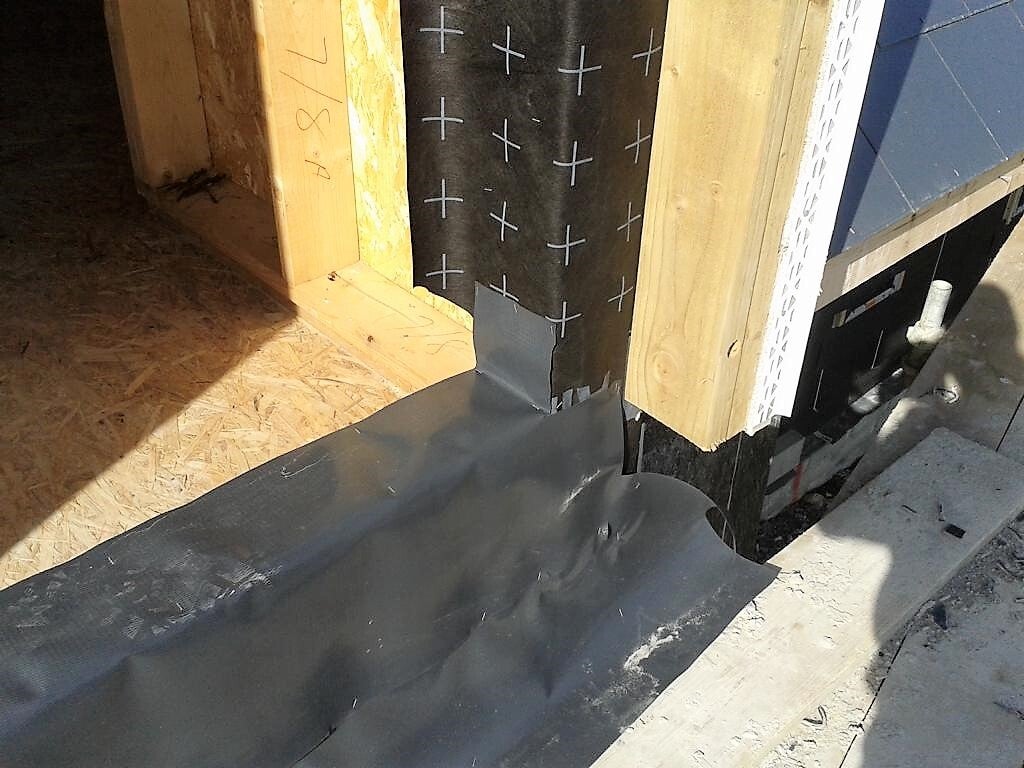
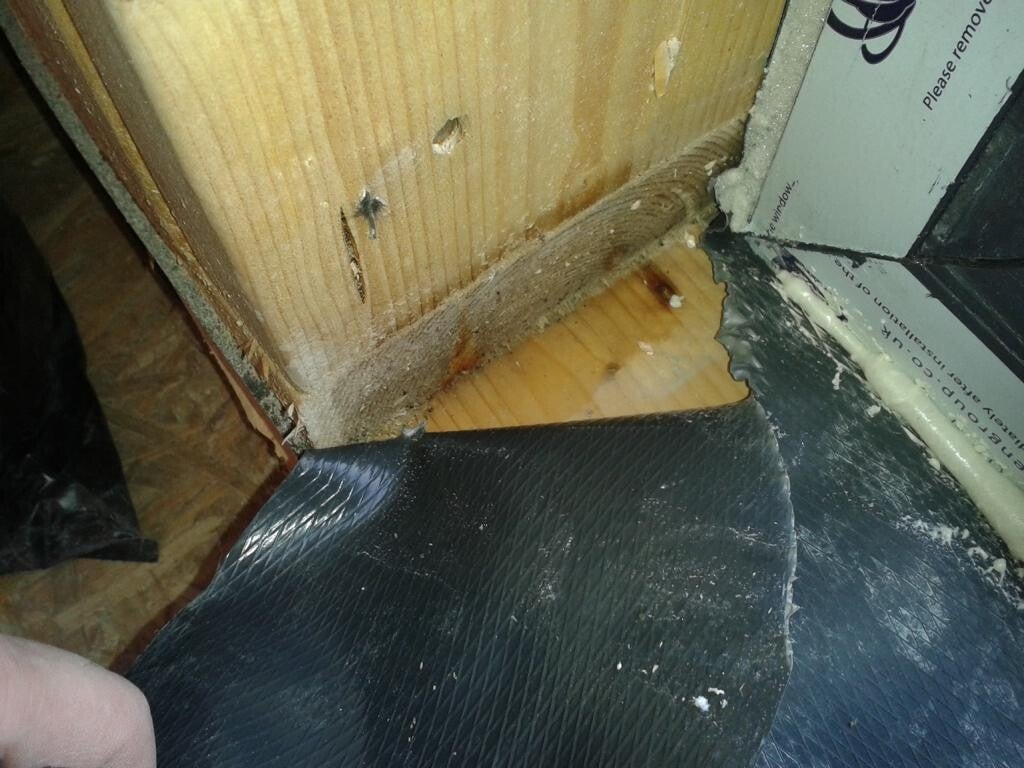
Every lap, fold, fixing and penetration creates another junction that has to be sealed correctly.
This can become particularly critical in timber-frame construction, where uncontrolled moisture entering the structure can have more serious consequences than in many mineral wall constructions.
The objective should therefore be to create a continuous and controlled waterproofing layer around the complete threshold detail.
2. Why Is Triotherm+ Different?
Triotherm+ is manufactured from high-density EPS and has very low water absorption.
According to the published technical data, its water absorption after 28 days of full immersion is:
≤ 0.5 vol.%
tested in accordance with EN 12087.
This means that the Triotherm+ material itself is highly resistant to moisture absorption.
However, moisture resistance of the material alone is not enough.
The junctions between the substrate, Triotherm+ upstand and door frame must also be properly sealed.


3. Sealing the Triotherm+ Upstand to the Substrate
The Triotherm+ upstand is bonded to the structural substrate using the specified Power Fix adhesive/sealant.
This creates a continuous connection between the upstand and the substrate while also helping to seal the junction against moisture ingress.
Any joints between individual Triotherm+ components should also be sealed in accordance with the system requirements.
The objective is to avoid uncontrolled water paths beneath or through the upstand.
4. Connecting the Door Frame
The junction between the Triotherm+ upstand and the door or window frame also has to form part of the overall waterproofing strategy.
Once the frame has been installed, the external threshold area should be sealed as part of the complete waterproofing detail.
This is where liquid-applied waterproofing can provide a significant advantage.
5. FLK Liquid Rubber Tanking
Our FLK Liquid Rubber Tanking can be used to form a continuous waterproofing layer around the door threshold and Triotherm+ upstand.
The liquid-applied system allows the waterproofing layer to follow the geometry of the upstand, frame and adjoining structure without relying solely on loose sheets or complicated folded membranes.
It can also be used to seal around fixing points and other penetrations within the threshold area.
The waterproofing is typically completed after installation of the door frame so that the relevant junctions can be incorporated into one continuous sealing detail.
6. Radon and Airtightness Membranes
Where a radon membrane, airtightness membrane or other building membrane is present, it still needs to be correctly connected to the door threshold detail.
Triotherm+ does not remove the requirement for these membranes where they form part of the building design.
Instead, the membrane should be connected to the Triotherm+ upstand using an appropriate tape or sealing system and integrated into the overall waterproofing strategy.
This is particularly important where mechanical fixings penetrate an existing membrane.
All such penetrations should be properly sealed.
The Important Point
The question is therefore not simply:
“Does Triotherm+ need a DPC?”
The better question is:
“How is the complete threshold waterproofing detail formed?”
Triotherm+ itself has very low water absorption, so a traditional loose DPC beneath the upstand is normally unnecessary when the correct system sealing is used.
However, the complete junction between:
Substrate → Triotherm+ → Door Frame → Waterproofing / Membrane
must still be designed and sealed correctly.
A successful threshold detail depends on continuity of waterproofing, not simply on adding another loose membrane beneath the door.